
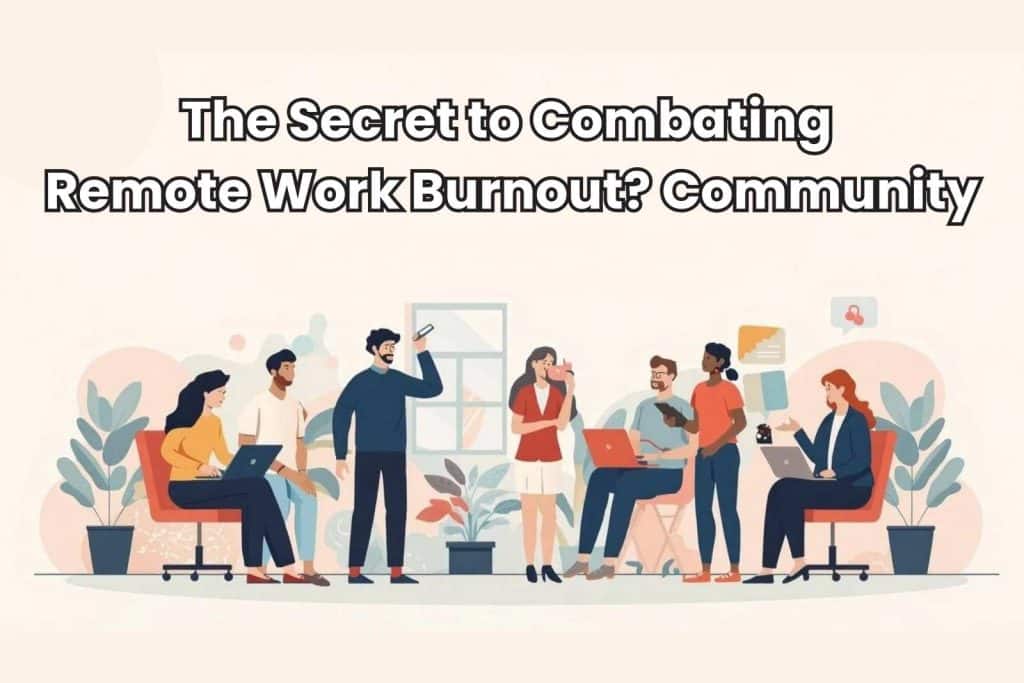
Remote work promised liberation: flexible schedules, zero commute, and the comfort of your own space. However, for a growing number of people, that initial sense of freedom has quietly become a burden. Instead, they face long, solitary days, ill-defined boundaries between work and life, and a persistent exhaustion that no amount of productivity tools seems to remedy.
You can optimize your schedule, upgrade your chair, and color-code your calendar, but if you’re doing all of it in isolation, burnout has room to grow. The real, often-overlooked antidote to remote work burnout isn’t another productivity hack. It’s a community—human connection, in-person and online, woven intentionally into your work life.
Why Remote Work Leaves You Drained (Even When You “Have It Good”)
On paper, nothing looks wrong: you have a decent job, solid Wi-Fi, maybe flexible hours and a comfortable setup. But your energy tells a different story.
Common signs of remote burnout include:
- Feeling “on” all the time, yet never truly present
- Logging more hours but getting less meaningful work done
- Struggling to switch off at night because your office is your living room
- Feeling oddly lonely, even with an overflowing inbox and busy calendar
What’s missing isn’t just better time management. Remote work quietly strips away:
- Natural boundaries – No commute, no visual cues of others packing up for the day
- Spontaneous connection – No hallway chats or “How’s it going?” moments
- Witnesses – Fewer people seeing your effort, stress, or progress
Humans are social creatures. When you mix continuous pressure with limited genuine connection, burnout isn’t just possible—it’s predictable.
Community: Not a “Nice Extra,” but Burnout Armor
When we think “burnout cure,” we often jump to individual solutions: meditation, exercise, better sleep. Those matters. But burnout is just as much a connection problem as it is a workload problem.
Community provides what solo work can’t:
- Normalization: Hearing “me too” cuts through shame and self-blame.
- Emotional buffering: Sharing struggles lightens their emotional weight.
- Perspective: Others help you see the difference between a bad day and a bad career.
- Healthy modeling: When people around you take breaks and set boundaries, you’re more likely to do the same.
The tasks on your to-do list may not change. But with community, your experience of those tasks does.
The Power of “Third Places”: Why Co-working Helps So Much
Sociologists talk about “third places”—spaces that are neither home nor traditional office, where people gather and connect. For remote workers, co-working spaces have become a powerful version of that third place.
Take a space like Freelance York in Dallastown, PA. On the surface, it offers:
- Flexible memberships (drop-in, day passes, monthly, dedicated desks)
- 24-hour access and high-speed internet
- Conference rooms, common areas, and a professional setting for calls
- Practical perks like printing, kitchen access, and event space
But beneath the amenities, co-working provides something more profound: rhythm and belonging.
When you work from a space like Freelance York:
- Your day gets a clear beginning and end—you arrive, you work, you leave.
- You’re surrounded by other focused people, which boosts your own motivation.
- You build “weak ties”—familiar faces, quick hellos—that quietly ease loneliness.
You don’t have to be the life of the room. Even working quietly at a desk, headphones on, your brain registers: I am part of a community. That alone can significantly reduce the emotional burden of remote work.
Community for Every Personality: It’s Not About Being “More Social”
A major barrier to building community is the belief that it requires being more outgoing, more talkative, more… something. In reality, the community should fit who you already are.
If You’re More Introverted or Quiet
Community might look like:
- Choosing a corner desk in a co-working space and simply working alongside others
- Attending occasional small events or workshops instead of big networking nights
- Joining a focused online group where you mostly read and occasionally contribute
You don’t need constant conversation to benefit from not being alone.
If You’re More Extroverted or Outgoing
You might thrive with:
- Regular meetups or events hosted by a co-working hub like Freelance York
- Virtual co-working sessions where cameras are on, and chat is open
- Starting a small lunch group or “remote coffee club” with fellow members
It’s not about performing. It’s about building a rhythm of connection that energizes you.
Beyond Friends: The Power of Micro-Communities and Weak Ties
Close friends and family are vital, but they’re not the only source of support. Remote workers benefit hugely from micro-communities and weak ties:
- Micro-communities: Small, consistent groups—like a 3–5 person mastermind, a recurring peer check-in call, or a tight-knit online circle. These spaces are where you can be honest about what’s working, what’s hard, and what you’re aiming for.
- Weak ties: The people you see regularly but don’t know deeply—other members at Freelance York, the barista who knows your order, the person who nods hello every Tuesday. They gently affirm that you exist in a social world, not a vacuum.
Both types of connection help your nervous system feel safer and less alone, which directly reduces burnout.
Build Your Support Grid: Place, People, Rituals
Instead of relying on willpower, think about building a support grid—structures that quietly protect your energy.
1. Place: Where You Work
Ask: Where do I feel more focused and less drained?
Consider:
- Working from a co-working space like Freelance York one or two days a week
- Using a quiet room, conference room, or dedicated desk for deep-focus days
- Occasionally swapping your home office for a shared environment to break monotony
A regular “out-of-home workday” can reset your brain and reduce that stuck, stagnant feeling.
2. People: Who Sees Your Work Life Up Close
These are the people you can be real with about work:
- One or two peers in similar roles or industries
- A small accountability or mastermind group
- Fellow regulars at your co-working space
They don’t have to know every detail—just enough to notice when you’re running on fumes and reflect your strengths back to you.
3. Rituals: How You Stay Connected
Connection is most sustainable when it’s built into routines, not left to chance.
Examples:
- Monday Start: Begin the week at a co-working space or in a virtual co-working session.
- Midweek Reset: A short check-in call or coffee with another remote worker.
- Friday Close-Out: A “wins and lessons” chat in a small group or quick debrief with a peer.
These rituals give your week shape—and ensure that connection happens even when you’re busy.
Gentle Experiments to Try This Month
You don’t need a total life overhaul. Start with small, compassionate experiments:
- Test a co-working day.
Use a drop-in or day pass at a space like Freelance York. Notice how your focus, mood, and stress compare to a typical home-office day. - Form a tiny support circle.
Invite two or three remote friends or colleagues to a recurring 30-minute call. Each person shares: one win, one challenge, one intention. - Join one intentional community.
Choose a local group, industry community, or online space for remote workers. Introduce yourself once, then simply show up regularly. - Pair connection with existing habits.
Plan your weekly review from a shared workspace. Schedule a quick chat after your biggest weekly meeting. Wrap up Friday with a “we survived” message thread.
You’re Not Failing—You’re Just Not Meant to Do This Alone
If remote work has left you exhausted, unmotivated, or strangely isolated, it doesn’t mean you’re not cut out for it. It usually means you’ve been trying to carry a full workload without enough human scaffolding around it.
Community—through co-working spaces like Freelance York, small peer circles, and intentional online groups—restores what remote work quietly takes away: rhythm, recognition, and the simple reassurance that you’re not in this by yourself.
Burnout flourishes in isolation. Community is how you reclaim your energy, your boundaries, and the joy of doing work that matters—without burning out along the way.