
While collaboration is conceptually positive, the actual experience can be daunting, especially when you are torn between sending a message, setting up a meeting, or attempting to handle a task alone. For those working independently or in remote settings, this awkwardness typically stems from systemic friction rather than personal ability. These challenges often manifest as three primary obstacles: a lack of context, high social stakes, and poor timing.
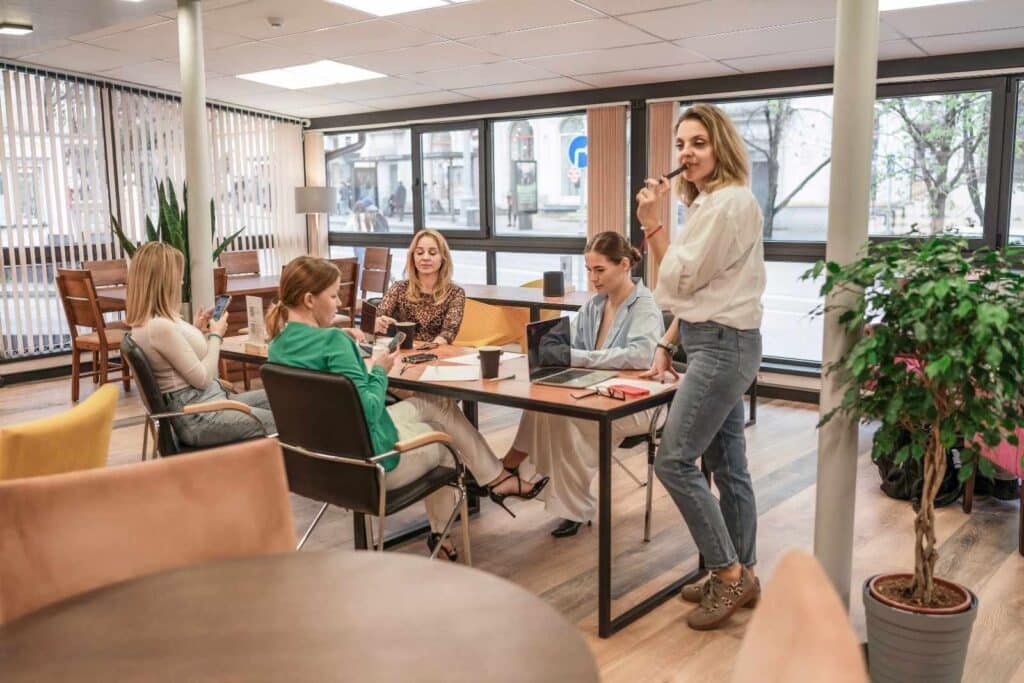
Coworking spaces change that. They make collaboration feel less like a formal event and more like a normal part of work. At Freelance York in Dallastown, collaboration doesn’t need a networking script. It can happen naturally—through shared space, low-pressure familiarity, and the right “containers” (like meeting rooms) when a conversation needs privacy and focus.
Why Collaboration Feels Awkward (It’s Usually Timing, Context, and Stakes)
When collaboration feels uncomfortable, we often blame personality: “I’m not a networker,” or “They seem too busy.” But awkward collaboration is usually a broken system with three common failure points:
Timing: In remote work, you either interrupt someone blindly via chat or schedule a meeting that feels too heavy for a small question. Without visibility into someone’s moment-to-moment workflow, you hesitate—and hesitation kills collaboration.
Context: Remote work strips away “ambient knowledge”—the casual background information you naturally pick up when you share space. In an office, you overhear what someone’s working on, you notice when they’re available, and you share a sense of what’s happening. Online, every interaction starts from zero.
Stakes: When the only way to collaborate is a meeting invite or a long message thread, everything feels high-stakes. A “quick question” starts to feel like a commitment. That makes people hold back, even when collaboration would genuinely help.
Coworking doesn’t eliminate these issues by magic. It solves them by restoring the missing collaboration conditions: visibility, shared context, and low-pressure entry points.
Collaboration Isn’t a Personality Trait—It’s a Skill (and the Environment Matters)
Some people look like “natural collaborators,” but most of what you’re seeing is not charisma—it’s repetition. Collaboration becomes smoother when you practice small, practical behaviors:
- Make the ask small and bounded
Instead of “Can you help me?” try:
- “Can I get 2 minutes of feedback on this?”
- “Do you know a good local bookkeeper/photographer/IT person?”
- “Does this headline make sense to you?”
Small asks lower social risk. They also respect time.
- Collaborate around an artifact
Ambiguous requests, such as “Let’s brainstorm,” often lead to awkwardness because they require participants to generate clarity from thin air. To make collaboration feel natural, it is essential to anchor the interaction with a tangible artifact:
- a proposal draft
- a landing page
- an email
- a pricing sheet
- a spreadsheet
People can react quickly to a real object. That’s easier, faster, and less socially weird.
- Close the loop
A simple follow-up turns collaboration into a healthy exchange:
- “That helped—thank you.”
- “Here’s what I changed based on your feedback.”
- “Happy to return the favor any time.”
Closing the loop lowers awkwardness next time because it builds trust.
The fundamental challenge is this: utilizing these collaborative skills becomes significantly more difficult in environments where the cost of interaction is high. Coworking spaces address this by lowering the “activation energy” needed to initiate a connection, making the process of working together much more seamless.
The Collaboration Ladder: Why Coworking Makes Connection Feel Natural
One reason collaboration feels forced is that people skip steps. Real collaboration usually follows a progression—call it a collaboration ladder:
- Recognition (you’ve seen each other; a nod becomes normal)
- Light context (“What do you work on?”)
- Micro-help (a quick answer, a resource, a referral)
- Lightweight collaboration (feedback on a draft, sharing a process)
- Repeatable collaboration (you help each other occasionally)
- Partnership (projects, referrals, shared clients, co-hosting events)
Remote work makes Steps 1–3 rare. Coworking makes them easy—because repeated proximity creates familiarity without requiring an intentional “networking moment.”
And this is the part many people miss: collaboration often starts before collaboration. It starts with small, low-pressure touchpoints that make asking a question feel normal.
The Architecture of Collaboration: Space Shapes Behavior
Collaboration isn’t only communication—it’s also architectural. Space shapes behavior in subtle ways:
Shared resources create natural openings. Kitchens, printers, entrances, and common areas create low-pressure moments where conversation can start without the awkwardness of a formal outreach.
Visibility creates timing cues. In a shared workspace, you can often tell if someone is heads-down or open to a quick question. That reduces interruptions and removes the anxiety of guessing.
Dedicated rooms lower social stress. Some conversations need privacy: client meetings, feedback sessions, planning discussions, sensitive business topics. When you have a proper room available, collaboration feels legitimate instead of improvised.
Freelance York’s mix of coworking areas and meeting spaces supports these different “modes” so collaboration fits the moment.
Collaboration That Doesn’t Derail Productivity (Containers Solve This)
A common fear is that collaboration becomes a distraction. That happens when collaboration has no container—when it’s always open-ended, always happening, and never clearly separate from deep work.
A healthier approach is to contain collaboration so it stays productive:
- Quick questions stay quick (hallway/kitchen moments)
- Deeper conversations move to a meeting room
- Focused work happens in focused zones
- Decisions get documented, then everyone goes back to work
This is one of coworking’s biggest advantages over coffee shops: coworking is designed for work first, with collaboration available when it helps—not constant noise.
Collaboration Isn’t Always Talking—Sometimes It’s Just Working Near Others
There’s also a type of collaboration that doesn’t get enough credit: parallel work. Simply working near other motivated people improves:
- momentum during slow weeks
- follow-through (because “everyone’s working, so I work”)
- resilience (you’re not building alone in isolation)
Even if you don’t speak to anyone that day, the environment supports better work. And when you do need help, you’re not cold-reaching strangers—you’re asking familiar faces.
Conclusion
The discomfort often associated with collaboration is typically a result of systemic issues—such as ambiguous timing, a lack of context, or high-pressure stakes—rather than a lack of personal aptitude. When interactions are low-stakes, frequent, and facilitated by an environment that streamlines small exchanges while providing structure for deeper discussions, working together becomes a natural process.
Coworking environments, such as Freelance York in Dallastown, foster these conditions by offering professional workspaces that encourage casual connection and private areas for focused collaboration. By removing the friction from these interactions, collaboration evolves from a forced activity into a standard, human element of productive work.