
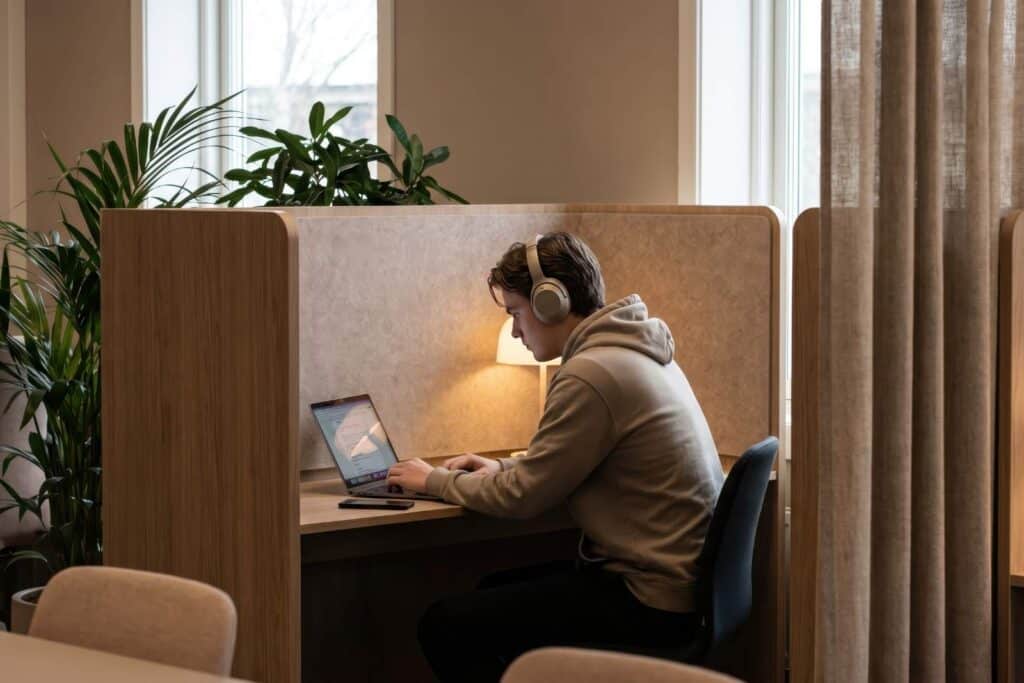
The phrase “I just work from home” might seem like a minor, casual remark used to keep a conversation light. However, that single word—just—carries significant weight. It subtly redefines your professional persona to others and, eventually, begins to reshape how you perceive your own career.
Moving beyond this specific language is a matter of synchronizing your professional identity with your actual circumstances, rather than an issue of pride. Removing that particular qualifier allows your communication to reflect the true weight of your contributions—the value you provide and the challenges you address. Often, this mental shift reveals that your work environment should reflect your professional level, transforming coworking from a mere luxury into a purposeful tactical decision.
1) “Just” Shrinks the Story You’re Living
The word “just” frequently acts as a linguistic buffer, utilized to prevent appearing overly assertive or self-absorbed. Nevertheless, when linked to your professional life—as in “I just work from home”—it can inadvertently communicate several negative connotations:
- This is temporary
- This is smaller than it sounds
- This isn’t fully legitimate
- I’m not worth taking up space
Even if your performance is strong, such framing fosters a cycle of repetition. This repetition carries weight: the more you characterize your profession as diminished, the more likely you are to treat it as such. This often leads to a failure to safeguard your schedule, a lack of investment in your professional environment, and a neglect of the routines necessary for high-quality work.
A simple swap makes a real difference:
- “I work remotely, mostly from home.”
- “I’m a freelancer/consultant/designer—I’m remote.”
- “I work from home, and I use a coworking space when I need focus.”
The identity signals we project have a profound impact on our actions, even when the underlying facts remain the same.
2) Boundaries Stop Being Optional When You Take Your Work Seriously
At home, boundaries are often invisible agreements with yourself:
- “I’ll start at 9.”
- “I’ll take lunch away from my desk.”
- “I won’t do chores between meetings.”
Unseen boundaries are easily compromised. They tend to dissolve when confronted by the typical interruptions of home life—such as incoming deliveries, family needs, the proximity of the kitchen, or the temptation of the couch. Succumbing to the cycle of “one quick thing” creates a recurring breach that impacts more than just your output. It erodes your self-trust, leading you to eventually question the validity of your own professional schedule.
Coworking turns boundaries into something physical:
- leaving home becomes the start ritual
- entering a workspace becomes the focus cue
- leaving the space becomes the end of the day
The goal is not rigidity, but rather the preservation of essential priorities: ensuring intensive productivity during business hours and facilitating genuine recovery once the day is done.
3) Focus Isn’t a Trait—It’s a System (And the Environment Is Part of It)
Many individuals view focus as an inherent personality trait—something you either possess or lack. In reality, focus is frequently the result of intentional design.
Home environments create constant micro-context switching:
- interruptions that seem minor but break momentum
- mixed-use spaces (work + bills + scrolling + meals)
- small friction points (clutter, noise, unstable routines)
Each one is a tax on attention. Even when you “get back to it,” your brain doesn’t re-enter deep work instantly.
The benefit of coworking lies in its ability to minimize distractions and establish a consistent routine; by simply arriving at the space, you signal to your mind, this is the place for productivity. As this habit takes hold, the environment acts as a catalyst, allowing you to engage more quickly and maintain focus for longer durations.
A simple way to test this is to run a “two-session” day in a coworking space:
- Session 1 (60–90 minutes): hardest, highest-value task
- Short break: reset
- Session 2 (60–90 minutes): second priority
Across two sessions of deep focus, many individuals achieve higher productivity levels than they would during an entire fragmented day working from home.
4) Opportunity Finds You Faster When You’re Not Always Alone
The act of working from home can subtly eliminate “weak ties”—those informal connections that frequently result in new projects, collaborations, creative concepts, and referrals. While emotional support often comes from close friends, significant professional growth is frequently sparked by acquaintances who:
- know what you do
- trust your vibe
- remember you at the right moment
By opting for coworking, you expand your “opportunity surface area” through ambient connection rather than forced networking. These casual interactions—familiar faces, brief hellos, and shared daily routines—allow others to naturally learn about your expertise over time. You simply need to be present and known to gain visibility, eliminating the need for a constant pitch.
5) Your Brain Needs Separation to Actually Recover
The inability for the brain to completely disengage is a common side effect of merging your living and working environments. This isn’t necessarily a result of workaholism, but rather a lack of environmental shifts; with your desk and laptop constantly in view, the persistent possibility of working creates a continuous mental strain that manifests as:
- guilt when not working
- struggles with relaxation
- a nagging sense of incompleteness regarding daily tasks
Coworking environments re-establish these necessary boundaries by providing a distinct physical departure from work. This transition allows for a true psychological break, enabling you to relax without being reminded of pending projects by the office equipment in your peripheral vision.
Furthermore, solitary work can lead to a sense of mental “flatness” characterized by diminished energy and momentum, even in the absence of true loneliness. Simply being in a shared professional space can raise your baseline levels of stimulation and motivation through the passive presence of others, providing a boost without requiring constant social interaction.
6) This Is Often a Growth Stage, Not a Forever Setup
The phrase “I just work from home” usually signifies a formative period where you are validating your professional path, establishing a routine, and gaining momentum. While this stage is perfectly valid, there are clear indicators when you have begun to surpass it:
- A desire for increased professional structure
- A need for more distinct work-life boundaries
- A craving for more profound concentration
- A yearning for an environment with professional vitality
Transitioning to coworking isn’t an attempt to replicate a corporate setting; rather, it is a strategic move to align your workspace with the current caliber of your professional operations.
Conclusion: Make the Shift Real (Not Just Mental)
Commit to a two-week experiment: eliminate the word just when describing your career. Observe the resulting transformations—not merely in your dialogue with others, but in how you structure your schedule, safeguard your professional boundaries, and value your own output.
To solidify this mental transition with a physical space designed for progress, Freelance York in Dallastown provides versatile membership tiers:
- Drop In: $30
- Basic Day: $100/month
- Entrepreneur: $175/month
- Dedicated Desk: $350/month
Witness the transformation that occurs when your workspace matches your professional goals by dedicating a full day to your most critical tasks.