
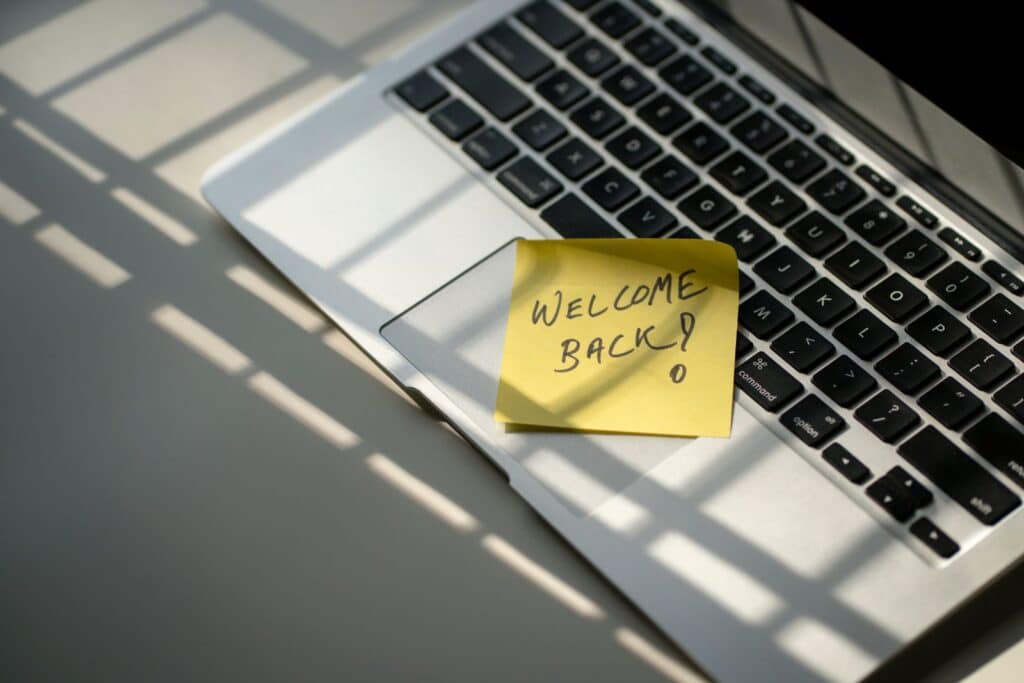
When vacation wraps up, your mind often feels sluggish right as your inbox begins to overflow. If returning to your normal pace takes longer than you anticipated, that is completely normal. It is not that you have lost your discipline, you’ve simply lost the structure that supports it: your daily routines, familiar cues, and a clear sense of what to prioritize first.
The fastest way to rebuild rhythm is to treat re-entry like a reset in three areas at once: your brain (attention + reward), your system (priorities + time blocks), and your environment (cues + fewer distractions). When those line up, momentum returns without you having to force it.
Why “Vacation Mode” Lingers (Even When You’re Motivated)
Most people try to solve post-vacation sluggishness with pressure: “I need to catch up.” But what’s really happening is more mechanical:
1) Your attention is still in wide mode
Shifting back to a work mindset requires significant energy, making the initial start feel unexpectedly heavy. This is because vacation and work demand opposite cognitive styles: while holidays encourage broad, wandering attention with minimal filtering, fewer deadlines, and high novelty, work requires narrow focus, strict prioritization, and task completion.
2) Your reward system changed
Even when you enjoy your job, transitioning back to work can feel unexciting initially. This happens because vacations provide constant micro-doses of dopamine from new surroundings, unplanned activities, and distinct meals. Rather than a lack of motivation, your brain is simply undergoing a period of recalibration.
3) Your cues got erased
You don’t run on willpower alone. You run on cues: commute, desk, coffee ritual, start time, even the clothes you wear. Vacation breaks those cues, so your work habits aren’t automatically triggered when you sit down again.
Re-entry is cue reconstruction. Once you rebuild a few reliable triggers, your rhythm returns faster than you’d expect.
The Re-Entry Framework: 5 Moves That Bring Rhythm Back (Fast)
This is a deep-dive approach you can use whether you’re freelancing, remote, running a small business, or balancing a full-time role.
Move 1: Do a “Soft Landing” (Even If It’s Only 2 Hours)
Avoid the major pitfall of jumping straight into intense tasks, dense inboxes, and meetings on your first day back. Instead, aim to set aside a 1-2 hour “soft landing” block if possible. If that isn’t feasible, ensure you safeguard at least the initial 60–90 minutes of your return.
Use that time for:
- reviewing your calendar and deadlines
- scanning messages (not replying to everything yet)
- reopening project notes and files
- writing a one-sentence success target: “Today, success is ______.”
This prevents your brain from associating “being back” with immediate chaos, and gives you a calmer on-ramp.
Move 2: Capture Everything, Then Sort It (Don’t Solve It Yet)
Rather than the actual workload, post-vacation stress typically stems from unresolved matters. Dedicate 25 minutes to a “full capture” session, listing everything weighing on your mind: tasks, messages, errands, ideas, and incomplete projects.
Then sort it quickly using three buckets:
- Now: 1–3 things that truly matter this week
- Next: important, but not first
- Not Yet: everything else (yes, even if it’s real)
This is how you reduce decision fatigue. You’re not ignoring tasks—you’re putting them into a structure so your brain stops trying to hold everything at once.
Move 3: Rebuild Focus Stamina With 90-Minute Anchors
You don’t need an eight-hour grind to regain control. You need proof that you can start and finish.
Use one or two daily 90-minute anchors:
- 5 min: define the outcome (“In 90 minutes, I will…”)
- 75 min: deep work (phone away, inbox closed)
- 10 min: close loops (save files, write the next step, tidy your workspace)
These anchors work because they reinforce completion. After vacation, completion is the quickest path back to confidence.
Move 4: Stop Letting Communication Decide Your Day
When you return, it’s tempting to live in your inbox to feel “caught up.” It feels productive, but it’s often just reactive. If you want rhythm, you need output.
Try:
- two message windows per day (a triage window and a response window)
- no inbox during deep work anchors
- a simple re-entry reply such as:
“Back from vacation today—thanks for your patience. I’m reviewing messages and will follow up by [day/time].”
This protects your focus while still keeping you responsive and professional—especially if you have clients or a team waiting on updates.
Move 5: Use Environment as a Productivity Multiplier (Not Willpower)
If you’re returning to work from home, the challenge isn’t only mental—it’s environmental. Home is full of cues that compete with focus: chores, comfort, interruptions, and “quick breaks” that quietly become 45 minutes.
A coworking space helps because it provides:
- context cues (“this is where I work”)
- fewer interruptions
- a clear start/stop boundary
- quiet social reinforcement (being around other working people makes work feel normal again)
Coworking doesn’t replace discipline. It reduces the amount of discipline you need to get started—and helps your new rhythm stick.
A Simple 3-Day Reset Plan (Coworking-Style, Even If You Don’t Co-work)
If you want something concrete, run this for three days:
Day 1: Orientation + one anchor
Capture, sort, pick one outcome, complete one 90-minute block.
Day 2: Two anchors + controlled communication
Hard task first, admin later, two message windows only.
Day 3: Ship something real + lock the routine
Finish a deliverable, then time-block the next three days so your rhythm doesn’t depend on “feeling ready__
By Day 3, most people feel noticeably more stable because rhythm is built through repetition, not intensity.
Burnout-Proof Rule: Use a Ramp, Not a Sprint
The fastest way to crash after vacation is trying to “make up for lost time.” A better goal is steady output:
- one deep block daily minimum
- a realistic backlog budget (for example: 60 minutes/day)
- micro-recovery (walks between blocks, lunch away from your screen, a hard stop time)
Sustainable rhythm beats heroic hustle. You’ll get more done—and you’ll feel better doing it.
Make Freelance York Your “Work Rhythm Home Base” (If You Want a Stronger Reset)
If your biggest struggle is restarting at home, a consistent place to work can be the missing piece. Freelance York in Dallastown is built to support focus with practical amenities like high-speed internet, Wi‑Fi printing, kitchen access, conference areas, and access options that fit different schedules—so you can rebuild routine with fewer distractions.
If you’re curious about coworking but don’t want to overcommit, Freelance York’s membership process starts with a Free Tour that includes a 1 Day Pass (8 AM–8 PM) with common space usage—enough to see how the environment feels when you’re trying to get your groove back.
Ongoing single-member options include:
- Basic Day: $100/month
- Entrepreneur: $175/month
- Dedicated Desk: $350/month
If you’d like to explore whether coworking could help you settle back into a steady work rhythm, you can learn more and schedule a tour here: https://freelanceyork.com/tour/